



When an agency or an institution joins HE Comply, the first thing they do is upload the contracts they already hold with partners. Those initial uploads generate some of the more interesting data, because so often the agreements being used have long before expired unnoticed.
Across everything uploaded, roughly a quarter of agreements that are still in use had already passed their end date. The real figure is probably higher, and drawing more accurate inferences is challenging since we allow users to store lapsed or archived contracts as well as current ones. Some agreements (<10%) have no end date at all, and some lapsed quietly when a variation went unsigned.
One agency’s CEO uploaded their 192 contracts (their entire portfolio) during a single onboarding session with us. They found more than 90 had expired. The CEO had not known. If the team had known, they hadn’t acted and hadn’t told the CEO. The agreements were in use, putting at risk any commission claim put to those 90+ [technically former] partners.
A cost few today can afford
What flows from a lapsed agreement is rarely dramatic, but potentially expensive. A student is placed. The commission claim goes in. Sometimes the institution honours it anyway, because the relationship matters more than the paperwork. Sometimes it does not, and the agency absorbs the loss. One agency has paid sub-agents out of its own funds for exactly this, rather than tell a referral partner the university refused.
But in a market constrained by government whimsy, every dollar matters today. Agents increasingly speak of the criticality of ‘optimising revenue’. This all starts with the commercial terms on which such revenue is generated.
The causes are so often mundane.
Nobody tracks the end date, or if they do it’s in a calendar reminder they’ve missed. The person who negotiated the agreement has moved on to a competitor firm, or the person recruiting against at the institution has never read it because their job started a year after it was signed. Plus, admin takes a back seat to business development, understandably.
Renewal is slow but the recruiting and relationship management cannot be. An agreement can sit in a renewal cycle for months while applications continue to flow against the old one. We see this with even Group of Eight institutions, content to operate months or even a year+ out of contract.
One university’s senior leadership told us their contracts lapse even though they notice them lapsing. They see it happen but have to prioritise other things ahead of renewal, as their team was cut back in these leaner times.
These can be costly errors
One large agency discovered it had been invoicing at the lowest of four commission bands since its contract was signed more than a decade ago, because nothing ever prompted a second look. The agreement sat with an administrator who had diligently transposed their commission to a spreadsheet sometime in the 2010s, and then the document had not been checked again.
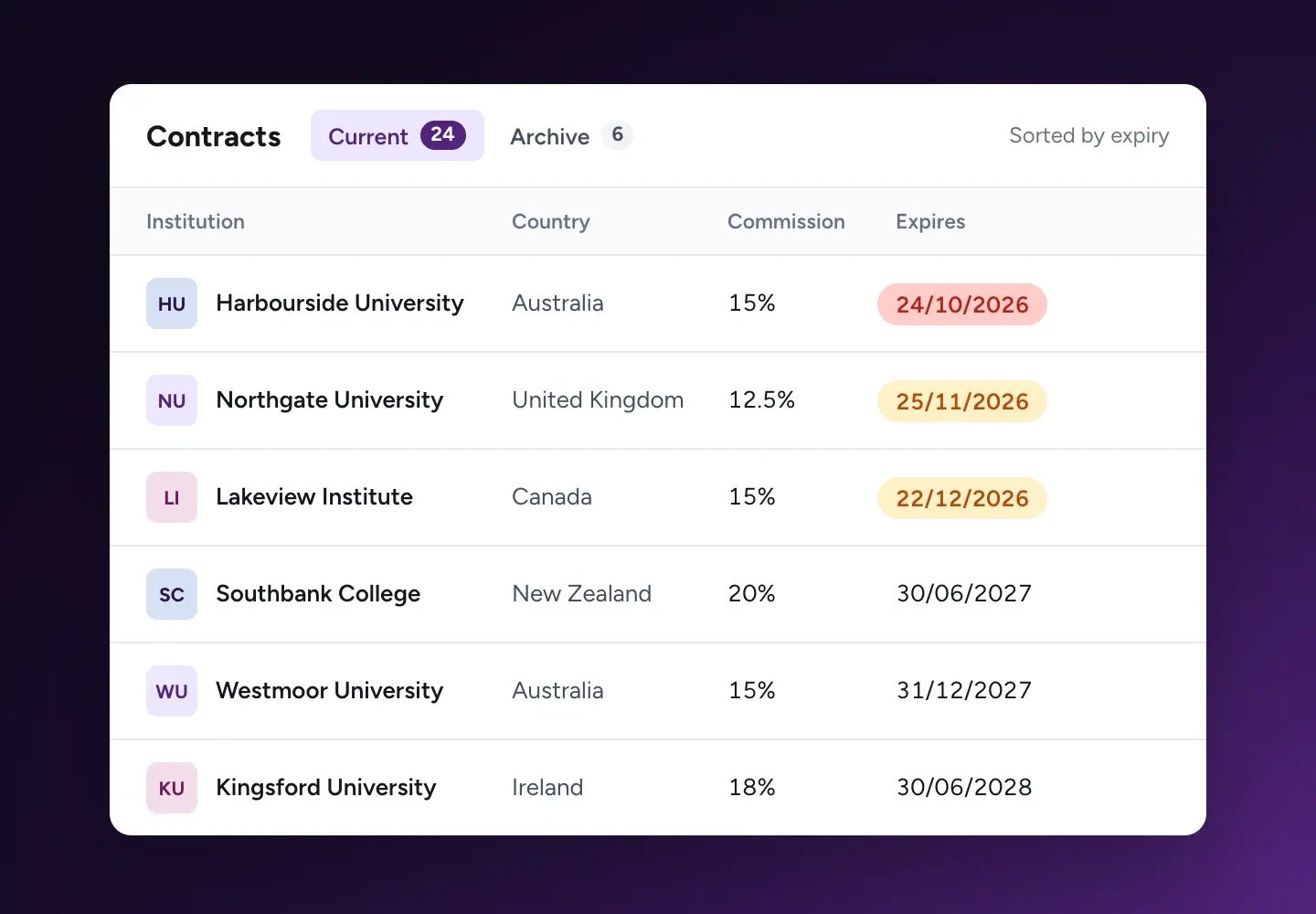
For providers the stakes can be read differently. Standard 4 requires a written agreement with every agent, and an agreement that expired two years ago is not a written agreement in force. Most providers will discover which of theirs have lapsed at the point somebody asks for the list, which may be an external audit.
And the fix is unglamorous. Get every agreement into one place, including the variations and bonus schedules that tend to arrive separately, later. Find out which have expired. Decide which of those relationships you want to keep, and renew those. Let the rest go.
Most organisations we work with find the first step - establishing your baseline - is the hardest one. Then it is just a list, and lists can be worked through.