



Every provider we meet today wishes to know the true extent of its agent recruiting network. None does fully. Gaining this visibility is challenging, since sub-agent networks are now complex and, often, very large.
We hear this consistently from small VET-sector colleges through to Group of Eight and Russell Group universities.
Securing contracts directly with quality universities has always been challenging; contracts are in many ways the prize, and venture-funded agencies have personnel whose sole purpose is to secure these prizes. I have written before about my time at The Australian National University where each year I personally would receive over 500 requests from agencies seeking a contract; none was ever approved. And so in a sector with many thousands more agencies than five years ago – China alone saw around 3,500 new agencies set up in 2024 – and in which the best universities have been ‘rationalising’ their partner agent networks, these prizes are scarcer still.
A large majority of agencies now run referral networks, usually called sub-agent networks by providers. A large proportion of agencies have built custom CRMs to manage these relationships, and some of the more organised master agencies issue contracts or terms-of-operation to their sub-agency partners.
Sub-agent volume ranges from a couple of dozen close sector contacts – perhaps agent CEOs in the same city or state – to 3,000+ sub-agents feeding a hungry application machine. The two extremes are very different and deserve different handling by the lead agency and any provider contracted with that lead agency.
Informal referral networks have always happened and are low risk; the two sides of that relationship have mutual professional capital invested and neither would wish to damage the arrangement. The volume play is very different, and providers really must see what runs from those partner agents’ nodes. ESOS now expects it in Australia, and yet we saw in 2026 how very few universities had any idea about sub-agents when asked by the NSW Parliament. Many universities in Australia and the UK (including some respondents to the NSW Parliament) simply deny the practice can occur, which is not a good governance position when legislation says otherwise.
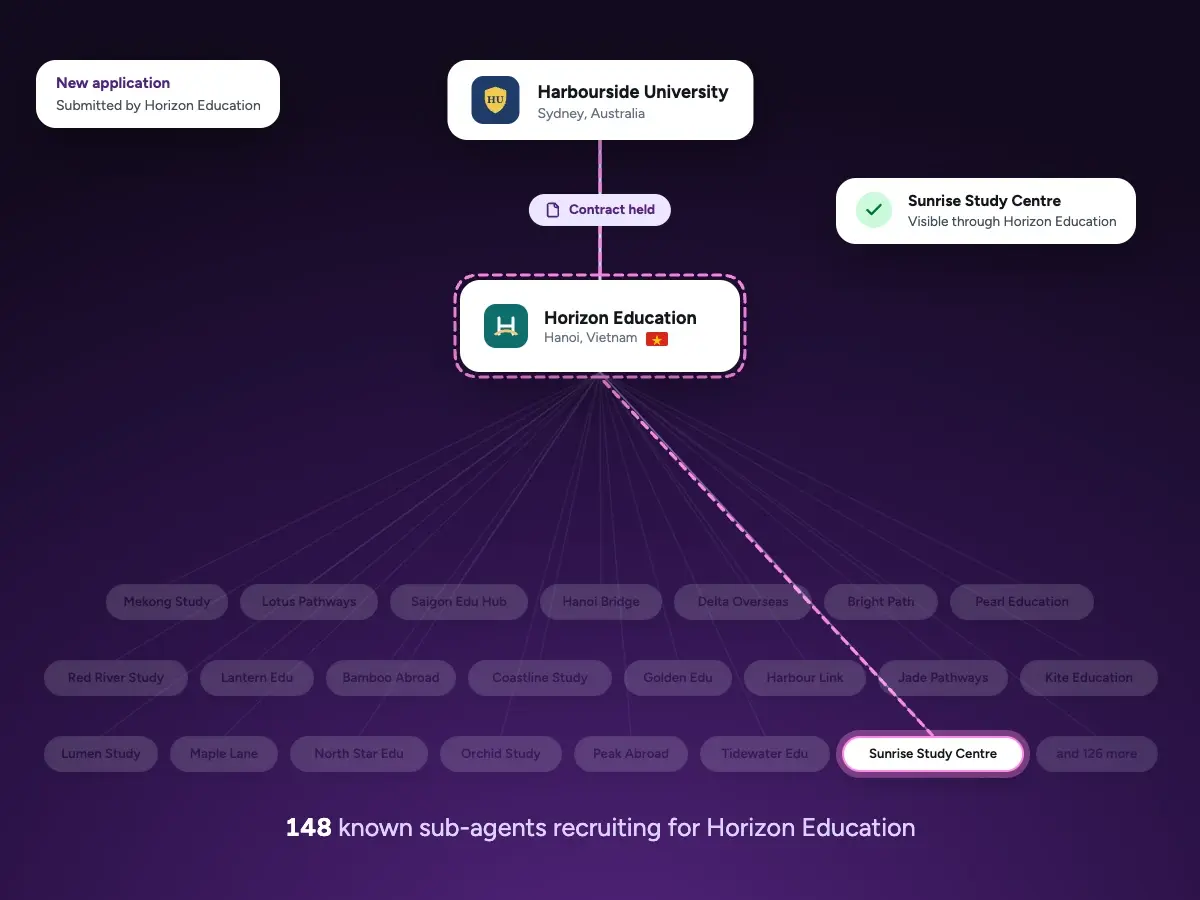
When we built a way for agency users in HE Comply to import and manage their sub-agent and super-agent relationships (because even master agencies are often sub-agenting to another agency which has a contract they themselves do not hold) we did so with these principles in mind:
- It has to be easier to use than a spreadsheet;
- It has to add value that multiple disparate systems (excel, WhatsApp, email) cannot;
- It has to save time and improve accuracy;
- It has to enable quick audit;
- It has to be able to be shared with partner providers if the agency chooses to share.
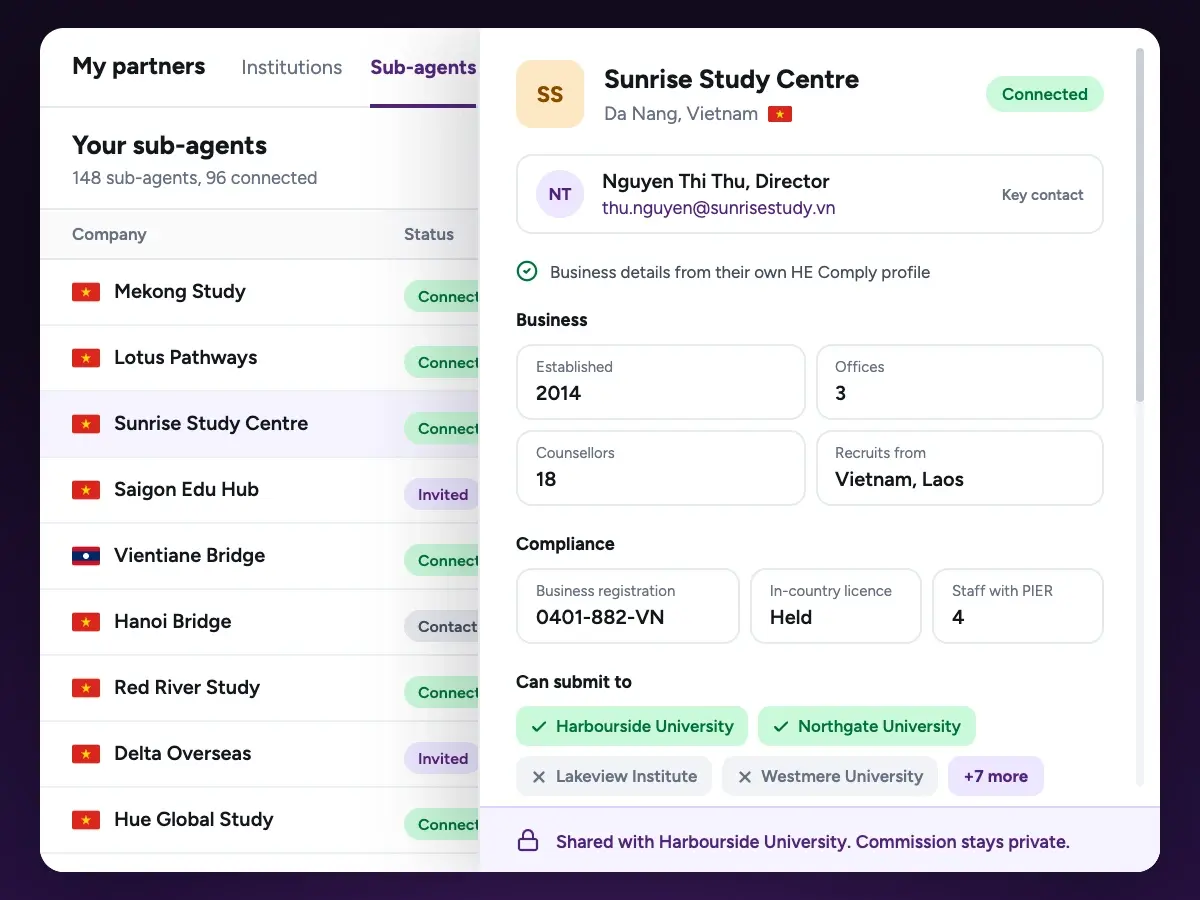
That last one is key, since the university is carrying the risk of sub-agent malpractice.
Indeed it can be argued the prospective applicants are carrying the most significant risk, often unknown, and so anything the university can do to mitigate or reduce this is both good reputationally and morally.